Image record
An ordinary room under the world
S11 · attempt 1
The exact prompt
This request includes exactly 2 design-reference images. Each image has a restricted role. Use the stated image content only for that role. Create a new composition from the complete scene description; do not reproduce the reference viewpoint or time of day unless the scene independently specifies it.

The first supplied image shows sub-plate car and vertical topology. Transit cabin design and up/down ordering; transfer oval glazing, grey rim, blue-grey bench, fixed fern and pressure-sealed transparent floor. The structural base is above the car and real vacuum below it.

The second supplied image shows repaired rust canvas bag. Bag construction and fabric only; transfer rounded flap, single brass buckle, oval cream patch, plain shoulder strap and short handle. Scene text sets the bag location and pose.

The text specifies current object locations, visible people, lighting and camera. The image references specify identity, design and material within those instructions. Do not introduce objects or people merely because they appear in a reference.

Create exactly one high-detail 3:2 landscape photograph. Render a single coherent moment, with realistic material detail and crisp water and foliage appropriate to a still exposure. Keep usable image content around the subjects. Do not make a storyboard, contact sheet, split screen, motion-blurred simulation, crop guide, label or diagram. Any normalized positions specify composition within the full image, with x increasing rightward and y downward; do not render those numbers.

Use photorealistic observational cinema, natural exposure and tactile material detail. Use rectilinear optics, soft highlight roll-off and very fine restrained grain. Preserve the difference between cool daylight, dry late sunlight and blue-black night; warm rooms have practical amber light. Give distant scenery atmospheric depth and keep foreground objects physically solid. People are comfortably dressed and absorbed in ordinary life. Architecture is personal and spacious. Avoid glossy resort advertising, decorative science-fiction clutter, excessive lens flare, fisheye distortion, posed glamour, captions, lettering, logos and borders.

The space habitat is a completed open bracelet 3,000,000 kilometres in diameter. Its 6,000-kilometre-wide living surface faces inward, holding land, water and atmosphere. Sloped, mostly transparent retaining walls rise 1,000 kilometres at the two lateral edges. Its exterior structural base faces vacuum. A real star outside the bracelet supplies light. The central Hub floats independently, with no spokes, and is too small to resolve in these views. There is no central sun, planet, enclosing dome or solid disk filling the opening. The spin is roughly day-long and has negligible visible rotation over a few real-time seconds.

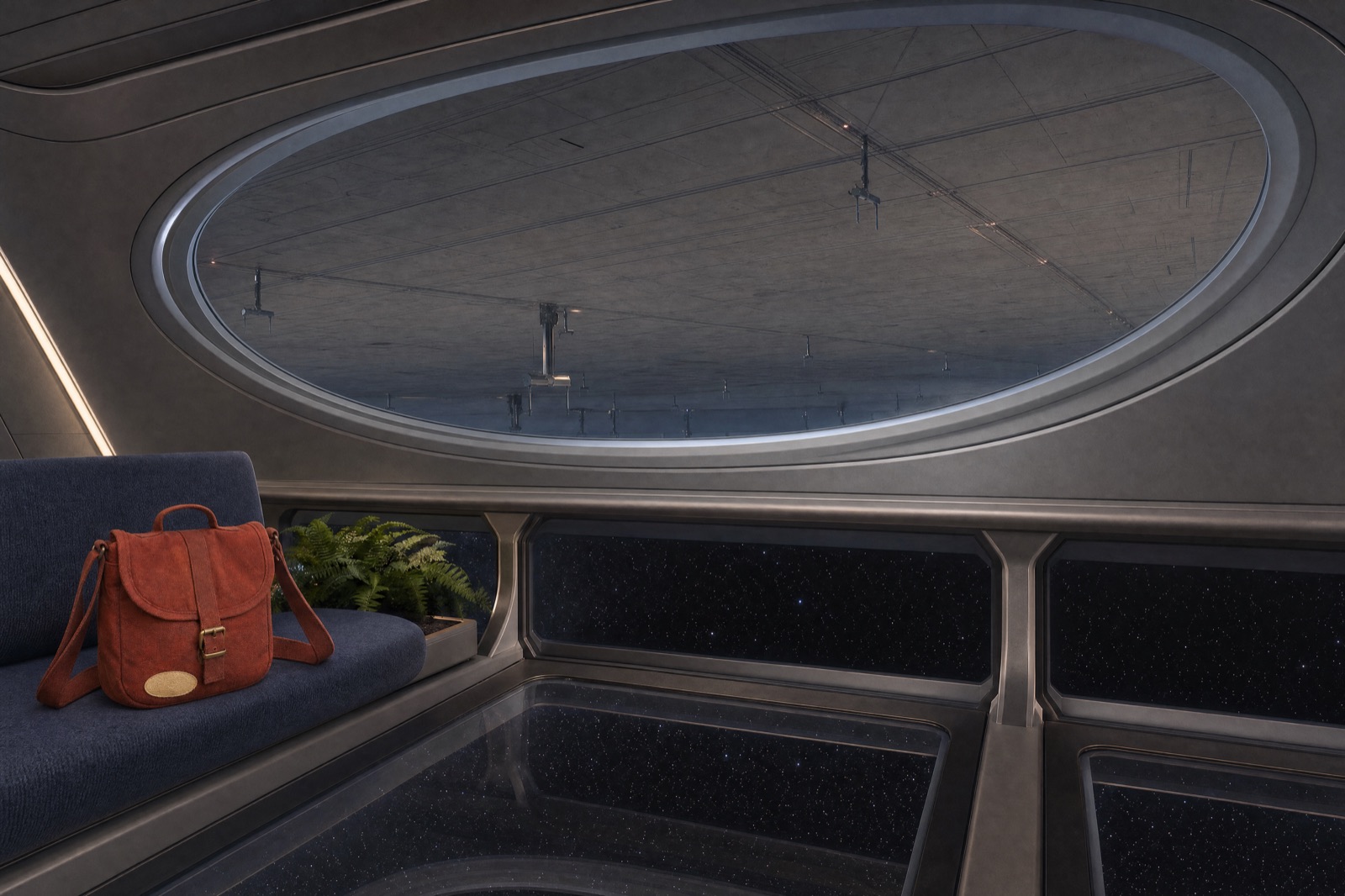
The vehicle is a sealed express car running below the exterior base of the habitat. Its large oval window has a satin-grey rim. Inside are a blue-grey upholstered bench and exactly one securely rooted fern in a fixed low planter. Transparent lower side panels and a section of the floor reveal sparse stars in actual vacuum beneath the vehicle. Through the upper glazing, the immense smooth grey engineered Plate base lies overhead, marked by fine guideway grooves and occasional hanging access masts. The inhabited landscape is out of sight beyond that base. The order is landscape, structural base, vehicle, open space. Keep pressure glazing intact, exterior reflections weak and the cabin comfortable. There is no atmosphere outside, open balcony, star pattern printed on the floor, glass ceiling showing a sky above a train, geological planet or thick mass of natural rock.

There is exactly one compact rust-coloured canvas shoulder bag, with a rounded flap, exactly one dull brass buckle and one oval cream repair patch low on its front. A plain canvas shoulder strap connects to the sides; a short top handle provides a handhold. The bag is lightly worn and carefully repaired. Its front details are physical fabric and hardware, with no logos, extra buckles, duplicate patches or ornamental distressing.

VISIBLE SUBJECTS
Bag only, no passengers.

PHOTOGRAPH
One wide 24 mm-equivalent rectilinear photograph inside a sealed express car below the habitat. The upper and middle parts contain an oval window, a blue-grey bench, one fixed fern and the repaired canvas bag. Above the car through the upper glass, a smooth grey engineered base bears guideway grooves and hanging masts. Sparse stars in real vacuum appear through the lower side panel and transparent floor. The near structures are optically sharp, as in a local pause. Preserve a clear order of structural base overhead, cabin in the middle and space below. Lower-frame cabin framework establishes that the stars are outside rather than printed on the floor. No exterior atmosphere, open door or star ceiling.

Render only the stated moment. Preserve a single internally consistent perspective and natural proportions.
Original production review
Full image and start/middle/end crop render checked. Downward crop reveals stars through floor glazing while retaining engineered base overhead, bag and fern. Render is 192 frames at 24 fps, eight seconds; source/crop bounds verified.