Image record
The water continues below the town
S05 · attempt 2
The exact prompt
This request includes exactly 1 design-reference image. Each image has a restricted role. Use the stated image content only for that role. Create a new composition from the complete scene description; do not reproduce the reference viewpoint or time of day unless the scene independently specifies it.

The first supplied image shows ternfall canal and watershed. Town architecture and watershed; transfer sandstone colour, bridge, pergola, pavilions, basin and separate waterfall outflow. Recompose from the scene camera, without copying the elevated viewpoint.

The text specifies current object locations, visible people, lighting and camera. The image references specify identity, design and material within those instructions. Do not introduce objects or people merely because they appear in a reference.

Create exactly one high-detail 3:2 landscape photograph. Render a single coherent moment, with realistic material detail and crisp water and foliage appropriate to a still exposure. Keep usable image content around the subjects. Do not make a storyboard, contact sheet, split screen, motion-blurred simulation, crop guide, label or diagram. Any normalized positions specify composition within the full image, with x increasing rightward and y downward; do not render those numbers.

Use photorealistic observational cinema, natural exposure and tactile material detail. Use rectilinear optics, soft highlight roll-off and very fine restrained grain. Preserve the difference between cool daylight, dry late sunlight and blue-black night; warm rooms have practical amber light. Give distant scenery atmospheric depth and keep foreground objects physically solid. People are comfortably dressed and absorbed in ordinary life. Architecture is personal and spacious. Avoid glossy resort advertising, decorative science-fiction clutter, excessive lens flare, fisheye distortion, posed glamour, captions, lettering, logos and borders.

This place occupies the inward-facing surface of a completed rotating space habitat: an open bracelet 3,000,000 kilometres in diameter, with a 6,000-kilometre-wide living strip and mostly transparent, sloped retaining walls 1,000 kilometres high at its lateral edges. A natural star far outside the bracelet provides daylight. The local landscape is almost flat, with extremely slight concavity along its length. Air, weather, water and vegetation are real. There is no roof, dome, central artificial sun, supporting spoke or planet inside the bracelet. Ordinary transport infrastructure is mostly concealed. Show no sky-band unless this composition explicitly asks for one.

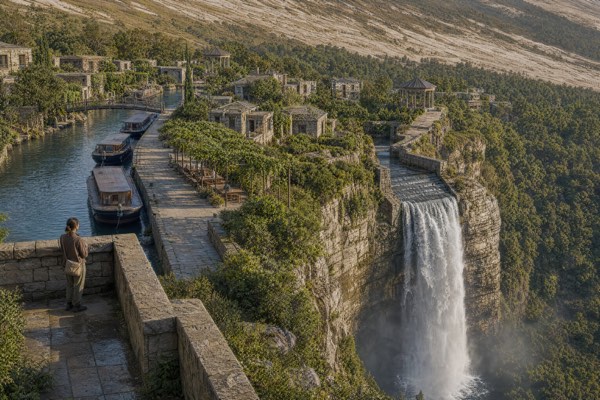
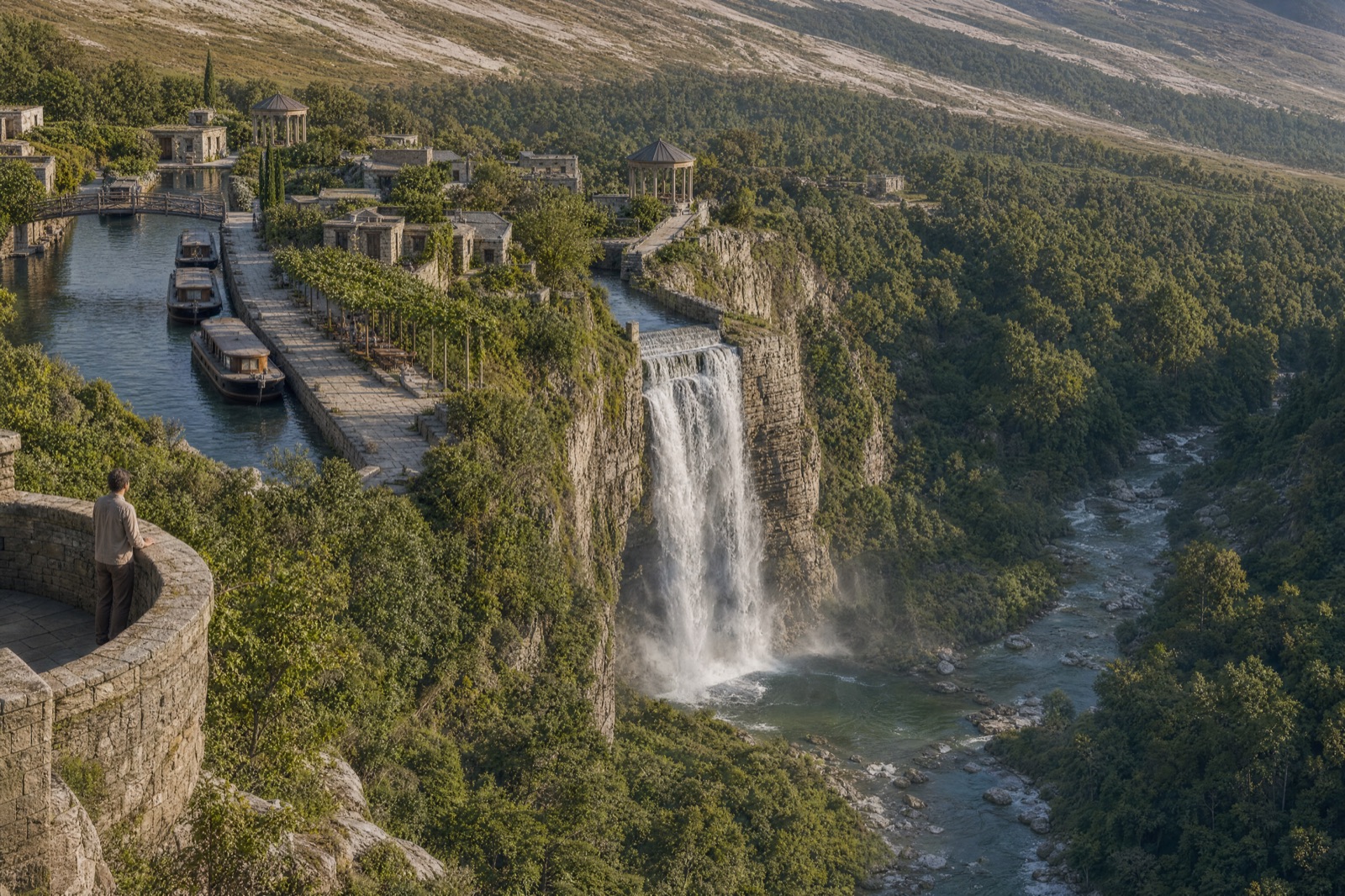
Ternfall is a spacious canal town built into warm-grey sandstone with occasional ochre layers. A navigable upper basin receives an upstream canal beneath one low wooden pedestrian bridge. Along one bank are a broad stone quay, a vine pergola and a shared table. Low irregular houses and two slender open pavilions stand in groups separated by gardens and water. A physically separate controlled outflow at the basin's downstream side reaches a broad cliff waterfall and a forested lower valley. Navigation stays away from that outflow. Wooded foothills and a pale mountain shoulder extend beyond the settlement. Keep a legible watershed, generous gaps and local materials, without a continuous crowded skyline.

VISIBLE SUBJECTS
One small lookout resident.

PHOTOGRAPH
A 35 mm-equivalent afternoon photograph from a stone lookout projecting beside a waterfall. The upper half contains a spacious sandstone navigation basin with three moored houseboats, low garden-separated buildings, a vine pergola and one wooden bridge. Near x=0.58 a separated outflow drops down an escarpment from y=0.42 to y=0.72, becoming a river through a forested lower valley. One small resident stands at the lookout parapet. Wet stone and fine spray are visible without obscuring the downstream river. Boats remain safely upstream of the separated outflow. Keep meaningful lower-valley detail, not blur. No water falls from the physical edge of the habitat. No sky-band.

Render only the stated moment. Preserve a single internally consistent perspective and natural proportions.

Use a wider and more elevated view from the same projecting lookout so the entire waterfall, its plunge pool and a substantial downstream river are all inside the image. The waterfall begins around y=0.40 and reaches its pool around y=0.67. The lower third clearly shows the connected river winding through forest toward the bottom-right distance. Do not crop off the base of the fall or the downstream river. Keep the single lookout resident small, at most one tenth of image height, and the three boats safely in the separate upper navigation basin.
Original production review
Full waterfall, pool and connected downstream river visible; safe separate upper basin with three boats.