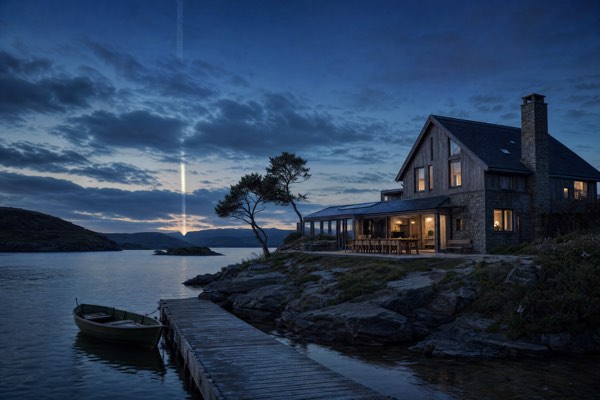
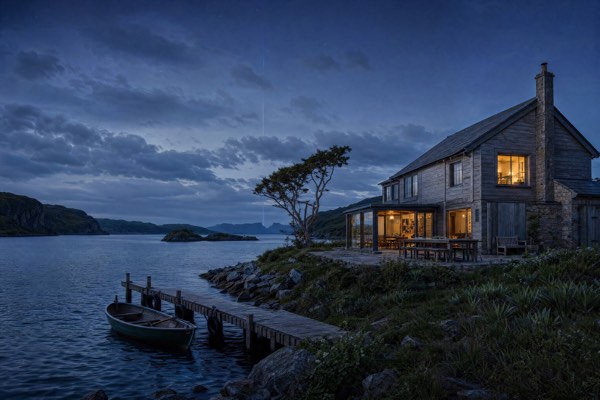
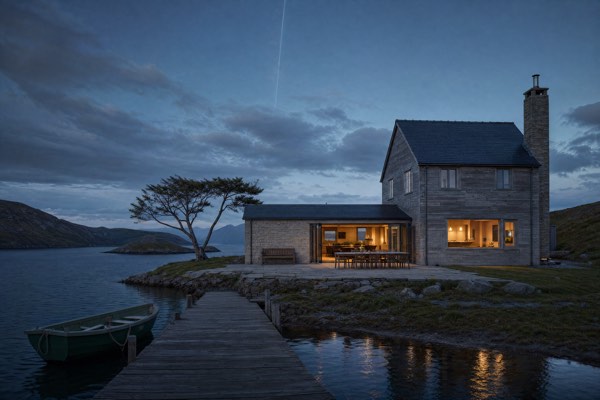
Image record
Reedwater House and inlet
R01 · attempt 3
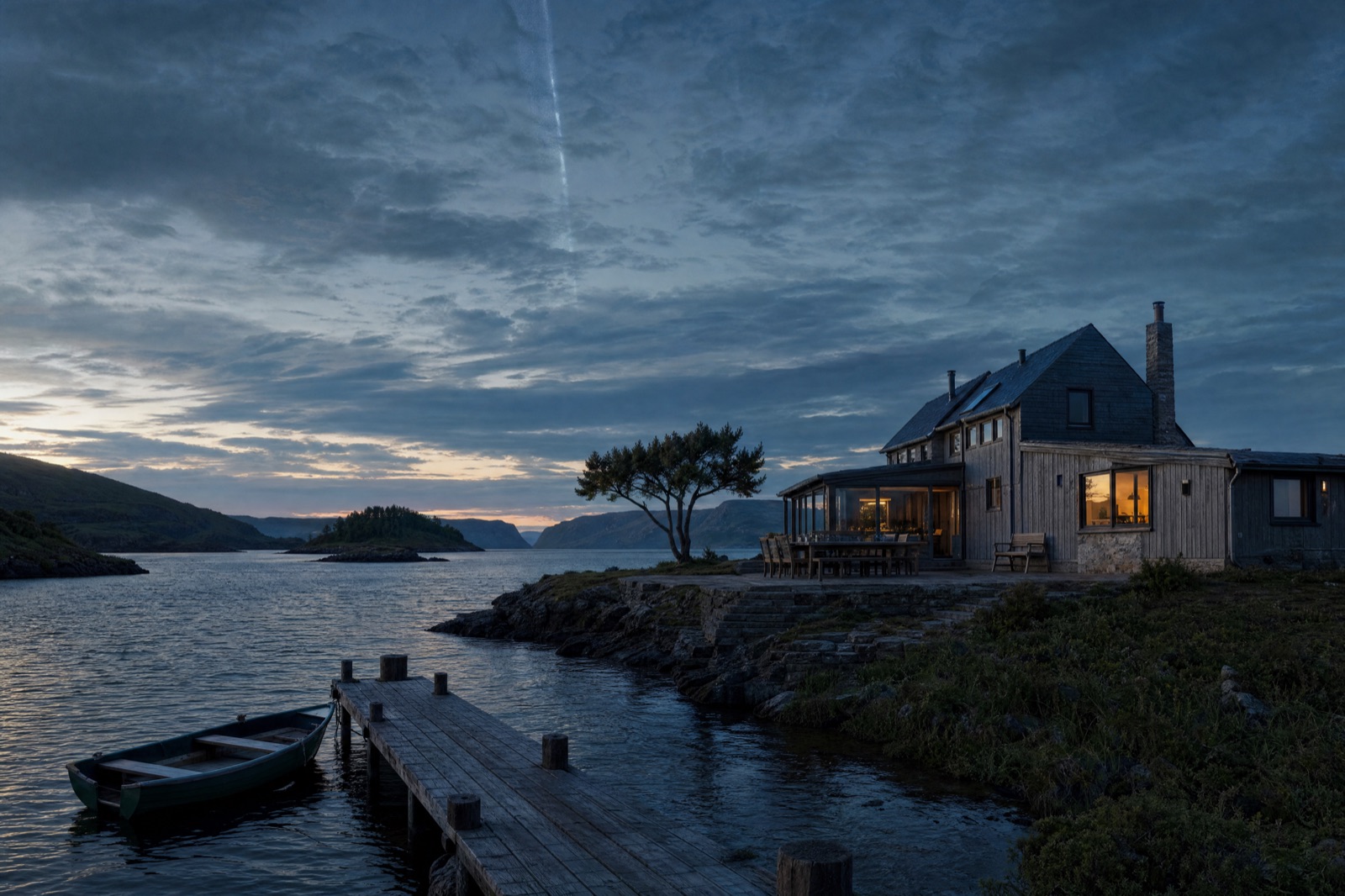
The exact prompt
Create exactly one high-detail reference photograph. This is one coherent image, without a contact sheet, labels, arrows or graphic panels.

Use photorealistic observational cinema, natural exposure and tactile material detail. Use rectilinear optics, soft highlight roll-off and very fine restrained grain. Preserve the difference between cool daylight, dry late sunlight and blue-black night; warm rooms have practical amber light. Give distant scenery atmospheric depth and keep foreground objects physically solid. People are comfortably dressed and absorbed in ordinary life. Architecture is personal and spacious. Avoid glossy resort advertising, decorative science-fiction clutter, excessive lens flare, fisheye distortion, posed glamour, captions, lettering, logos and borders.

This place occupies the inward-facing surface of a completed rotating space habitat: an open bracelet 3,000,000 kilometres in diameter, with a 6,000-kilometre-wide living strip and mostly transparent, sloped retaining walls 1,000 kilometres high at its lateral edges. A natural star far outside the bracelet provides daylight. The local landscape is almost flat, with extremely slight concavity along its length. Air, weather, water and vegetation are real. There is no roof, dome, central artificial sun, supporting spoke or planet inside the bracelet. Ordinary transport infrastructure is mostly concealed. Show no sky-band unless this composition explicitly asks for one.

Reedwater House stands on a low shelf beside a sheltered inlet. It is an asymmetrical two-storey home of weathered grey timber and pale stone, with two unequal dark-slate pitched roof sections. A tall narrow chimney stands on the right of its waterfront facade. One large kitchen window has a warm amber interior. A lower glazed dining wing adjoins the main building on its left and opens onto a stone terrace. A long timber dining table stands OUTSIDE on that terrace immediately in front of the open glazed doors. A plain wooden bag bench stands against the exterior wall just left of those doors. A forked, wind-bent tree stands farther left of the dining wing. From the water-facing approach, the house is in the right third and open water fills the centre and left. A short timber jetty projects diagonally from this shore toward the lower-left foreground. Beyond the open water lie two unequal headlands, a low hooked island between them and a distant ridge with one V-shaped notch. Keep the inlet physically continuous; the headlands and island do not surround the house as a decorative moat. Show only architectural features actually visible from the camera.

The household boat is one small dark-green open hull with a low grey-green gunwale and plain timber seating. Its movement is smooth and gentle without visible violent propulsion. Its current location is specified by the scene; never place a duplicate of this boat at the jetty.

This camera is level, unrolled and aimed approximately anti-spinward along the ring circumference, close to the strip's mid-width plane. In this rectilinear view the centreline of the distant illuminated habitat projects nearly vertically in the sky, rising from the distant notched-ridge direction near the middle of the frame and continuing out of the top edge. The zenith lies outside this landscape image. Show an extremely narrow silver-blue ribbon that tapers with distance, with lower sections lost in haze and nearer cloud occluding it. It belongs to the continuous ground-bearing ring under the observer. There is no separate hoop above a planet. Do not resolve continents or buildings in the sky-band. Do not draw a rainbow arch, horizontal Saturn-like belt, wide road across the sky, glowing portal, artificial sun or supporting spokes. Preserve believable night exposure; the house light remains more prominent than the ribbon.

Make a single 3:2 landscape location photograph from a low water-facing viewpoint near the outer jetty at late blue hour, using a level 28 mm-equivalent lens aimed anti-spinward. Show the house on the right, its lower glazed wing, exterior table, left-of-door bench, forked tree and short diagonal jetty. The dark-green boat is moored on the jetty's left side. Include open water at centre-left and distinguishable distant headlands, hooked island and notched ridge. Keep the sky ribbon faint and very narrow. No people obscure architecture. All essential landmarks fit within the central 85 percent of the image.

Specific composition and terrace correction: the ENTIRE house occupies only the rightmost third of the scene, and its rightmost wall stops at 85 percent of total image width, leaving landscape visible to its right. Move the camera back enough to include the entire two-roof house, and do not crop any roof or wall. Keep the forked tree to the left. There is exactly ONE plain wooden bag bench, on the exterior wall immediately to the LEFT of the open glazed dining doors. Put NO bench or chair against the wall to the right of those doors. The long dining table remains outside in front of the doors. Keep this terrace arrangement clearly readable despite the wider landscape framing. The sky ribbon is a nearly invisible, very narrow desaturated silver-blue reflected line, partly lost behind cloud: no luminous beam and no bright white or yellow segment.
Original production review
House still extends beyond right frame edge and bench remains to the right of dining doors. Three candidates exhausted; one deliberate simplification and final attempt allowed by QC checkpoint.