Image record
A lifetime in a few channels of sand
S08 · attempt 2
The exact prompt
This request includes exactly 2 design-reference images. Each image has a restricted role. Use the stated image content only for that role. Create a new composition from the complete scene description; do not reproduce the reference viewpoint or time of day unless the scene independently specifies it.

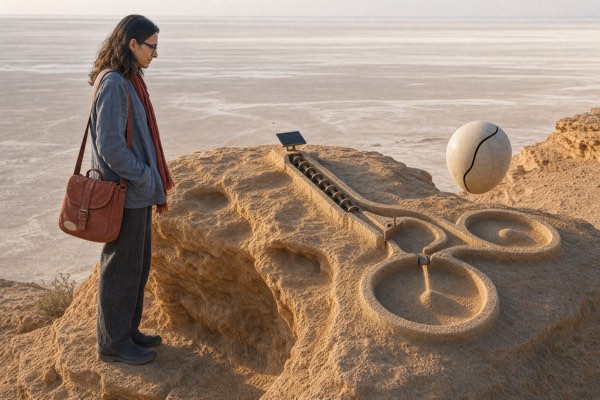
The first supplied image shows sand artist and artwork. Desert sculptor and artwork design; transfer pale ceramic shell, dark seam, solar collector, screw, channels, two basins and routing gate. The scene text determines the gate state and whether Aren is present.

The second supplied image shows aren with repaired bag. Traveller identity and clothing; transfer face, shoulder-length dark-brown hair, rectangular dark teal-blue eyeglasses, body proportions, jacket, scarf, trousers and shoes. The image also establishes the bag design. Do not transfer the portrait pose or background.

The text specifies current object locations, visible people, lighting and camera. The image references specify identity, design and material within those instructions. Do not introduce objects or people merely because they appear in a reference.

Create exactly one high-detail 3:2 landscape photograph. Render a single coherent moment, with realistic material detail and crisp water and foliage appropriate to a still exposure. Keep usable image content around the subjects. Do not make a storyboard, contact sheet, split screen, motion-blurred simulation, crop guide, label or diagram. Any normalized positions specify composition within the full image, with x increasing rightward and y downward; do not render those numbers.

Use photorealistic observational cinema, natural exposure and tactile material detail. Use rectilinear optics, soft highlight roll-off and very fine restrained grain. Preserve the difference between cool daylight, dry late sunlight and blue-black night; warm rooms have practical amber light. Give distant scenery atmospheric depth and keep foreground objects physically solid. People are comfortably dressed and absorbed in ordinary life. Architecture is personal and spacious. Avoid glossy resort advertising, decorative science-fiction clutter, excessive lens flare, fisheye distortion, posed glamour, captions, lettering, logos and borders.

This place occupies the inward-facing surface of a completed rotating space habitat: an open bracelet 3,000,000 kilometres in diameter, with a 6,000-kilometre-wide living strip and mostly transparent, sloped retaining walls 1,000 kilometres high at its lateral edges. A natural star far outside the bracelet provides daylight. The local landscape is almost flat, with extremely slight concavity along its length. Air, weather, water and vegetation are real. There is no roof, dome, central artificial sun, supporting spoke or planet inside the bracelet. Ordinary transport infrastructure is mostly concealed. Show no sky-band unless this composition explicitly asks for one.

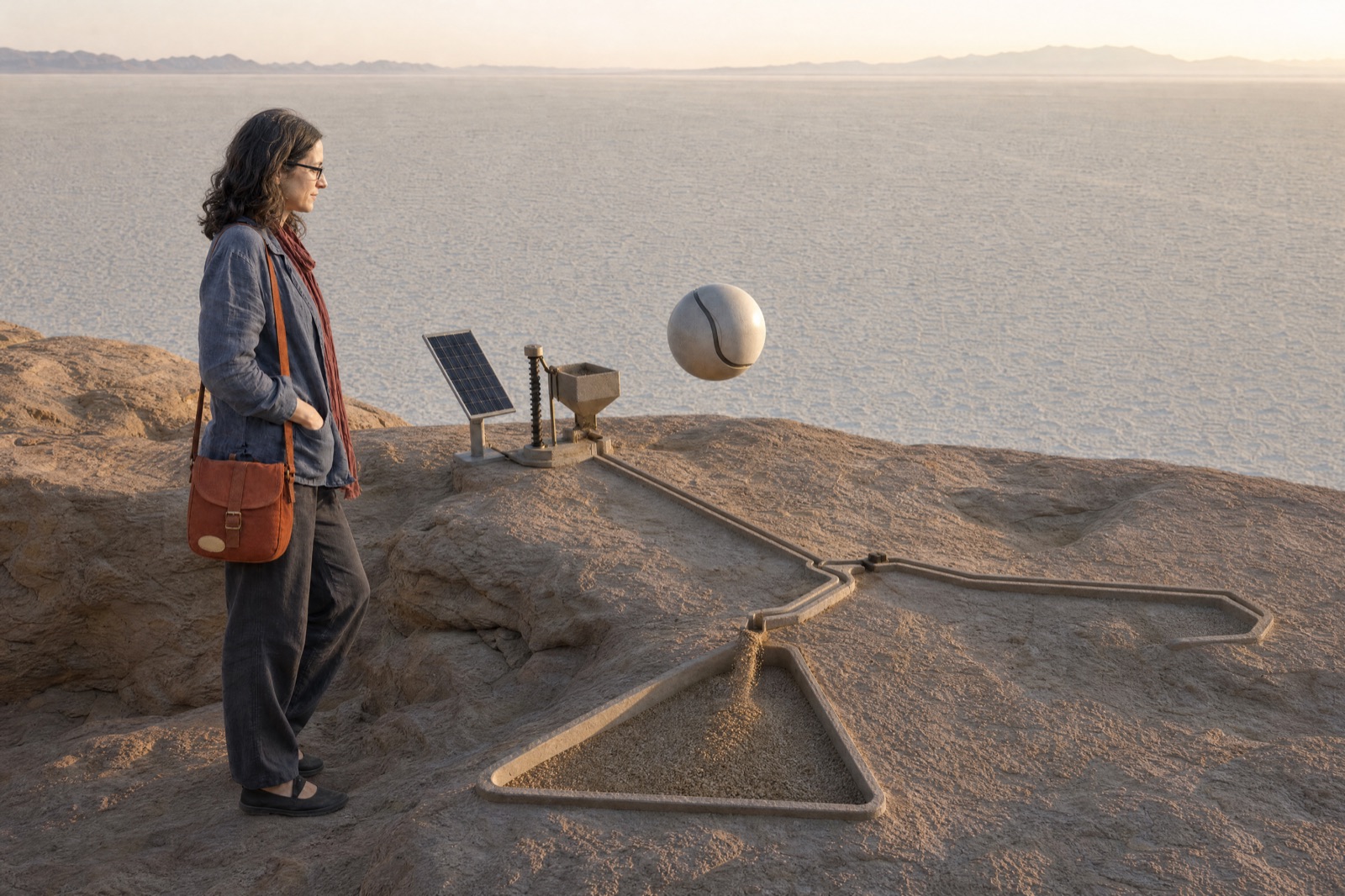
The desert artist is an independent machine citizen: a pale ceramic shell about 45 centimetres across, with one asymmetrical dark seam, no face, no rotors and no limbs. Its sandstone outcrop contains an asymmetrical dry-sand artwork. At the far left, a small visible solar collector powers a short upright lifting screw feeding a compact elevated hopper. From the hopper, narrow polished channels bend across the stone in an offset branching layout. They lead to exactly two unequal shallow angular basins: a long trapezoidal basin in the near-left part of the artwork and a smaller irregular quadrilateral basin farther back on the right. The basins are separated by a generous expanse of uncarved stone; they do not touch or form a side-by-side pair. Neither basin is circular or oval. The short side-mounted screw does not point between the basins or run along their centreline. A small gate at a channel junction diverts one dry granular stream between the basins, with one fine fall active at a time. The machine manipulates the gate with an invisible local field; the gate moves without an invented arm or visible magic beam. Sand is dry granular material, with no liquid meniscus, glowing particles or water splash. The outcrop overlooks an immense pale salt desert.

Aren is a woman around 35 years old, with light skin, an oval face, dark brown eyes behind slim rectangular dark teal-blue eyeglasses, a slender straight nose, defined lips and a slim build. Their dark-brown hair falls to the shoulders, parted near the centre and worn loose with a slight natural wave. Their face has softly contoured cheeks, a gently tapered jaw and a rounded chin, with natural skin texture appropriate to a woman in her mid-thirties. Preserve this female casting and age consistently in every view; do not age Aren into middle age or substitute a male traveller. They wear a loose blue-grey linen jacket, a narrow muted rust-red scarf, charcoal trousers and dark flat walking shoes. Their appearance is relaxed and unposed, with realistic proportions. Keep the facial proportions, shoulder-length dark-brown hair and rectangular glasses consistent across camera angles. Hair has no contrasting temple streak. Do not mirror the person or add jewellery, uniform elements or a spacesuit.

There is exactly one compact rust-coloured canvas shoulder bag, with a rounded flap, exactly one dull brass buckle and one oval cream repair patch low on its front. A plain canvas shoulder strap connects to the sides; a short top handle provides a handhold. The bag is lightly worn and carefully repaired. Its front details are physical fabric and hardware, with no logos, extra buckles, duplicate patches or ornamental distressing.

VISIBLE SUBJECTS
Aren and one pale ceramic artist only.

PHOTOGRAPH
A human-height 50 mm-equivalent late-afternoon photograph on a sandstone outcrop above an immense salt desert. Polished dry sand is caught in a fine stream through carved channels, a small lifting screw, two shallow basins and one tiny granular fall. A modest solar collector is integrated into the stone. A pale ceramic machine citizen hovers near x=0.58, y=0.47 beside its small routing gate. Aren stands in partial profile at x=0.32, with the repaired rust bag at the hip, looking attentively at the artwork. Keep the machine and visitor equally engaged in considering the work. Hands and shell are anatomically simple; the distant desert is softly lit. No robot face, visible magic beam, water effect or sky-band.

Render only the stated moment. Preserve a single internally consistent perspective and natural proportions.

Use the corrected woman aged about 35 from image 2. Place her entire head and body with generous headroom inside the central 80 percent of image height, so a later 16:9 crop can retain her head and the artwork together. Keep her near the left third. Use the separated unequal ANGULAR basins, bent channels and short upright far-left screw from image 1. One dry granular fall only.
Original production review
Corrected Aren and new angular sand artwork; one active fall, artist and separated unequal basins. Full head clear.