Image record
Wind-driven cable carriage
R05 · attempt 2
The exact prompt
Create exactly one high-detail reference photograph. This is one coherent image, without a contact sheet, labels, arrows or graphic panels.

Use photorealistic observational cinema, natural exposure and tactile material detail. Use rectilinear optics, soft highlight roll-off and very fine restrained grain. Preserve the difference between cool daylight, dry late sunlight and blue-black night; warm rooms have practical amber light. Give distant scenery atmospheric depth and keep foreground objects physically solid. People are comfortably dressed and absorbed in ordinary life. Architecture is personal and spacious. Avoid glossy resort advertising, decorative science-fiction clutter, excessive lens flare, fisheye distortion, posed glamour, captions, lettering, logos and borders.

This place occupies the inward-facing surface of a completed rotating space habitat: an open bracelet 3,000,000 kilometres in diameter, with a 6,000-kilometre-wide living strip and mostly transparent, sloped retaining walls 1,000 kilometres high at its lateral edges. A natural star far outside the bracelet provides daylight. The local landscape is almost flat, with extremely slight concavity along its length. Air, weather, water and vegetation are real. There is no roof, dome, central artificial sun, supporting spoke or planet inside the bracelet. Ordinary transport infrastructure is mostly concealed. Show no sky-band unless this composition explicitly asks for one.

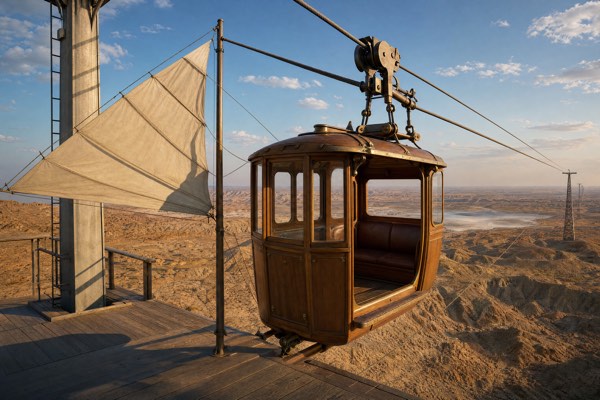
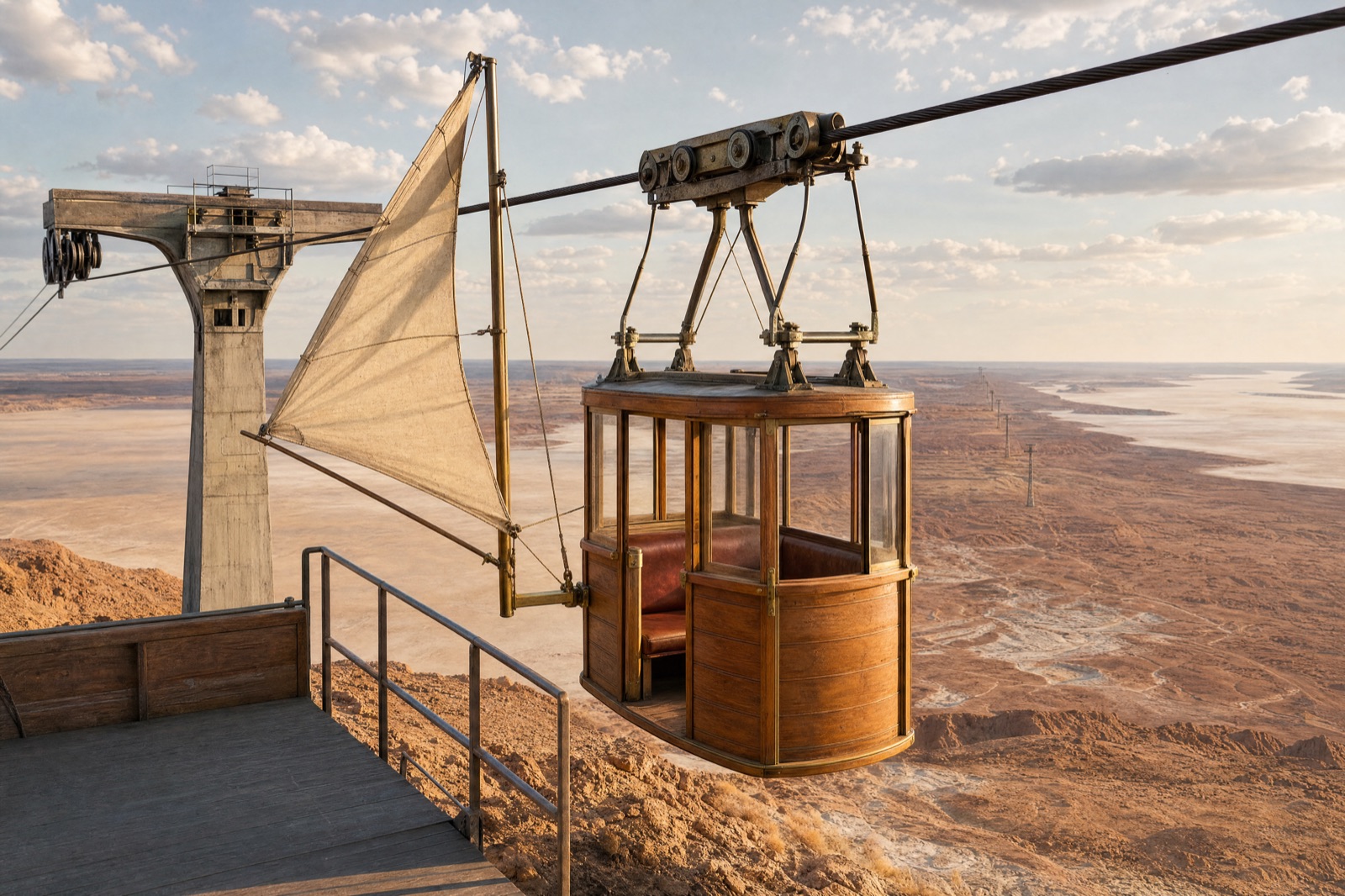
The wind-driven cable carriage is a six-person cabin of honey-coloured wood, clear glazing and maintained dull brass, with a leather bench and a painted ceiling. A wheeled trolley physically contacts one continuous load-bearing overhead cable. Visible hangers connect the trolley to the cabin roof. A slender mast is offset to the cabin's left, clear of the trolley and cable; a triangular cream sail is attached to the mast with real ropes. The sail can pull the trolley along the line. Forty-metre pylons support the route across dry ochre sandstone badlands with branching gullies and a pale salt pan. The sail, loose fabric and grasses respond to one coherent crosswind. The cable never detaches, passes through the mast or changes into a rope hanging the vehicle from the sky. There is no balloon, steam engine, propeller or ornamental gearwork.

Make one unlabelled 3:2 engineering-clear photographic view of the cable carriage parked at a small boarding platform above dry sandstone country in late sunlight. Use a 28 mm-equivalent three-quarter view that reveals trolley wheels touching the cable, roof hangers and offset sail mast. Show the entire cabin with its open side window, leather seat and wood sill, without any passenger or bag. One nearby pylon and several diminishing pylons indicate route scale. Show a real assembled vehicle, without exploded diagrams or labels.

The sail mast is a PART OF THE MOVING CABIN. Its foot is fastened to the cabin left-side frame by two short rigid brackets, and moves with the cabin. No part of this mast touches the boarding platform, the ground, or the pylon. Keep a clearly visible open-air gap below its foot. The sail, its ropes, its mast, the cabin, roof hangers and trolley form one traveling assembly. The mast stays well to the left of the single overhead running cable. The station pylon has no sail. Use simple maintained construction without decorative brass mechanisms.
Original production review
Sail mast is now attached to cabin frame with foot clear of platform; trolley, hangers and continuous cable are connected. Sail and cabin form one moving assembly.